The question
Standard joystick controls do not suit every child’s motor, sensory or cognitive abilities. How can powered mobility respond to an input method that matches a child’s reliable movement, while providing appropriate assistance and supervision?
The approach
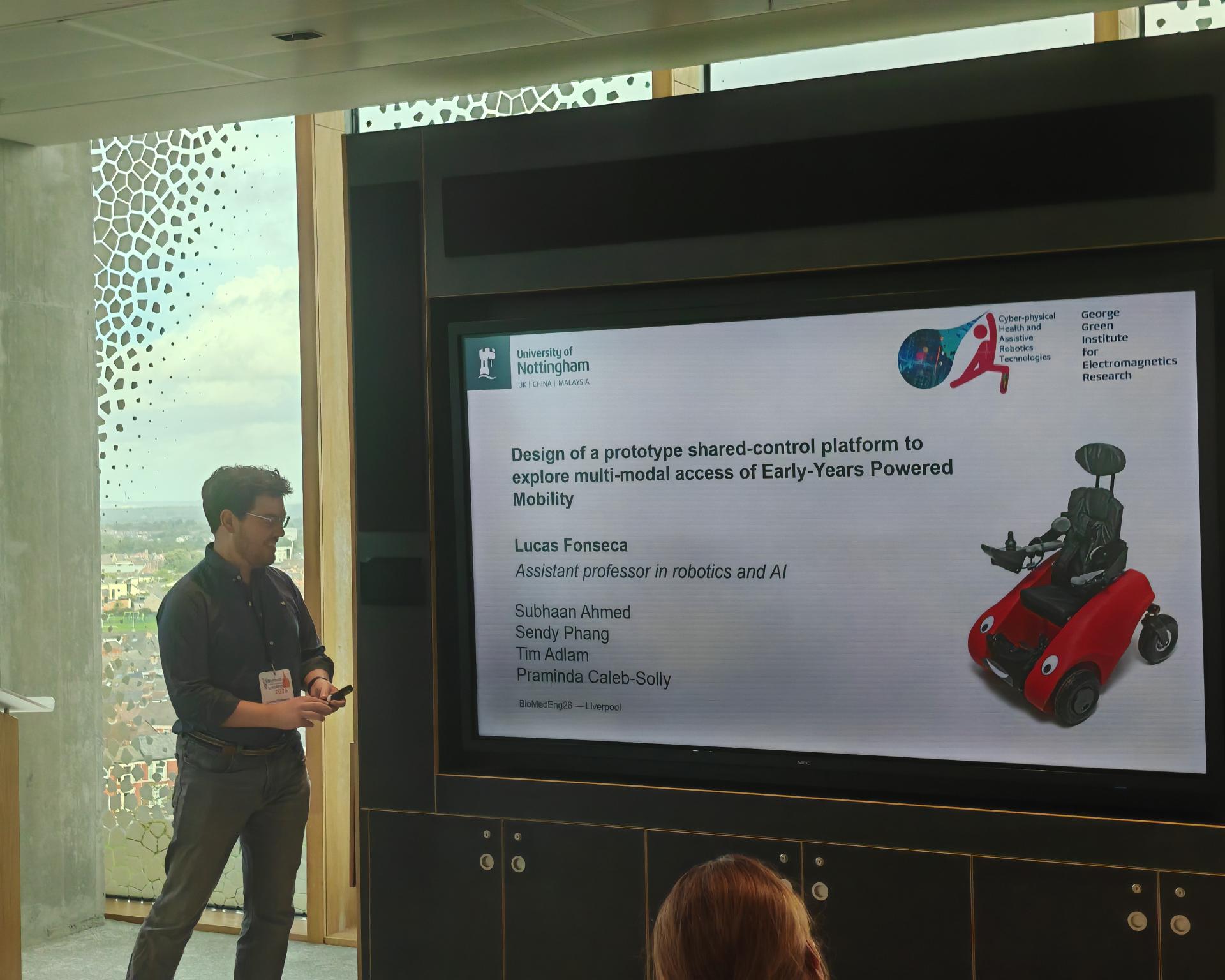
SMILE is a modular research platform that can combine head tracking, wearable movement sensing, touch and carer input. Different access methods map to a common command space, supported by a ROS 2 architecture for sensing, safety states and navigation assistance.
The child, the system and the carer have defined roles. The aim is to make assistance adaptable to context, with carers able to supervise, override or recover when needed.
Current stage
The prototype includes head-control and command-mapping capabilities. Planned co-design with children, families and clinicians will explore useful mappings, understandable feedback and acceptable levels of assistance.
This is a research prototype, not a clinically validated mobility product. User participation and evaluation are part of the next stage of work.
Working together
The project is supported by University of Nottingham Research Growth Funding. It brings opportunities for collaboration in accessible interaction, paediatric mobility, shared control and participatory design.